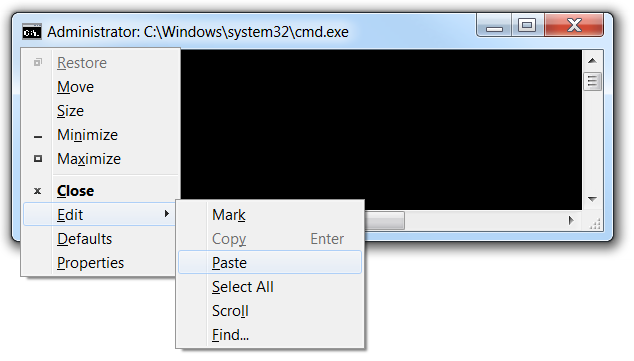
I find working on the command line in Windows frustrating, primarily because the console window is wretched to use compared to terminal applications on linux and OS X. Commands in Windows 7. The command prompt that has been in previous versions of Windows is still with us and is not much changed fron Windows Vista.

Windows Device Console (Devcon. You can use Dev. Con to enable, disable, install, configure, and remove devices. Dev. Con runs on Microsoft Windows 2.

Windows. Dev. Con (Devcon. WDK, Visual Studio, and the Windows SDK for desktop apps. For information about downloading the kits, see Windows Hardware Downloads. Windows Driver Kit (WDK) 8 and Windows Driver Kit (WDK) 8. Windows. Sdk. Dir%\tools\x. Windows. Sdk. Dir%\tools\x.


Windows. Sdk. Dir%\tools\arm\devcon. Note The Visual Studio environment variable, %Windows. Sdk. Dir%, represents the path to the Windows kits directory where the kits are installed, for example, C: \Program Files (x. Windows Kits\8. 1.
You can also use the Dev. Con commands (enable, disable, install, start, stop, and continue) in scripts to test the driver. Dev. Con is a command- line tool that performs device management functions on local computers and remote computers. Note To run Dev. Con commands on a remote computer, the Group Policy setting must allow the Plug and Play service to run on the remote computer. On computers that run Windows Vista and Windows 7, the Group Policy disables remote access to the service by default.
Chkdsk – Guide for Windows XP, Vista, 7, 8. Depending if you run the utility from Command Prompt or Recovery Console, the following parameters are different. Command-line reference A-Z. In addition to the tools installed with Windows. Some command-line tools require the user to.

On computers that run WDK 8. WDK 8, the remote access is unavailable. Devcon features include: Display driver and device info Dev. Con can display the following properties of drivers and devices on local computers, and remote computers (running Windows XP and earlier): Hardware IDs, compatible IDs, and device instance IDs.
These identifiers are described in detail in Device Identification Strings. Device setup classes. The devices in a device setup class. INF files and device driver files.
Details of driver packages. Hardware resources. Device status. Expected driver stack. Third- party driver packages in the driver store. Search for devices Dev. Con can search for installed and uninstalled devices on a local or remote computer by hardware ID, device instance ID, or device setup class.
Change device settings Dev. Con can change the status or configuration of Plug and Play (Pn. P) devices on the local computer in the following ways: Enable a device. Disable a device. Update drivers (interactive and noninteractive)Install a device (create a devnode and install software)Remove a device from the device tree and delete its device stack.
Rescan for Plug and Play devices. Add, delete, and reorder the hardware IDs of root- enumerated devices. Change the upper and lower filter drivers for a device setup class.
Add and delete third- party driver packages from the driver store. Restart the device or computer Dev. Con can restart a local device, reboot the local system on demand, or reboot the local system if required for another Dev. Con operation. Dev.
Con source code. The Dev. Con source code is also available so that you can examine the methods that Dev.
Con uses to retrieve and change setup and configuration data. Dev. Con illustrates the use of general setup functions, device installation functions, and Pn.
P Configuration Manager functions. The source code for the Device Console (Dev. Con) Tool is available in the Windows driver samples repository on Git. Hub. Dev. Con Commands. Dev. Con Examples.
Send comments about this topic to Microsoft.
How to Get to the Recovery Console in Windows. One of the most useful tools for fixing problems in Windows 7 and Windows Vista is the Recovery Console, as long as you know where it is and how to activate it. The Recovery Console is available from either the F8 start- up menu or any Windows installation or recovery disc. Here are the steps to take for starting the Recovery Console from the F8 boot menu: Restart the computer.
After the start- up message appears, press the F8 key. You must press F8 before Windows starts. Choose the option Repair Your Computer. At this point, your computer may start a custom recovery program, such as the Rescue and Recovery tool available on Lenovo PCs. If so, you should either attempt to access the Recovery Console by using this utility. Click the Next button. You may be prompted to choose a keyboard layout and language.
You usually have no need to change these options. Choose your username. If you know the administrator’s password, you can choose Administrator. The password should be the same as on your own user account, though it may not be. Select only an account that has administrator access.
Type your password and click OK. A window appears on the screen, listing several repair and recovery options and tools. Your PC may not have these same options.
For example, Dell Factory Image Restore appears only on Dell computers. You’re now ready to use the Recovery Console commands. When you’re done using the command prompt, close its window. Choose the option Restart from the System Recovery Options window. The computer restarts. In some cases, the preceding steps may not get you to the Recovery Console. You may instead find a special recovery program or another utility.
Don’t give up! It’s still possible to access the Recovery Console by using a Windows installation or update disc or the recovery disc that came with your computer. Follow these steps: Insert the Windows or system recovery disc into your PC’s optical drive. Restart the computer. Choose the option to boot from the CD or DVD.
Work your way through the installation process until you find the option Repair Your Computer. Don’t worry: Nothing is changed on your computer until you choose to reinstall Windows. But you’re not doing that. Press the R key to choose the option Repair Your Computer. If prompted, don’t choose to repair any start- up or boot issues or errors. You can return to fix any errors later. Choose the Windows Vista installation from the list.
Click the Next button. The System Recovery Options window appears. Choose the Command Prompt option. Say hello to the Recovery Console.
When you’re done using the command prompt, close its window. Choose the option Restart from the System Recovery Options window. The computer restarts. The Recovery Console isn’t a friendly place. Go there only when you know what you’re doing or when you’re following directions, like the ones given here.


/http%3A%2F%2Fimg.appnee.com%2Fappnee.com%2FMySQL-Front-3.png)
/http%3A%2F%2Fimg11.hostingpics.net%2Fpics%2F515193demo.png)
/https%3A%2F%2Fi.ytimg.com%2Fvi%2FPfwakKQe32o%2Fhqdefault.jpg)
/http%3A%2F%2Fpraxistipps-images.chip.de%2Fvl2DrcFGex8ZbikLhOsXm2A8iYY%3D%2F0x0%2Ffilters%3Ano_upscale%28%29%3Aformat%28jpeg%29%2Fwww.chip.de%2Fpraxistipps%2F1749351944_41f30ffca1.jpg)