Change Default Installation Directory In Windows 1. I redirected the installation path for my Program Files from C: \ to P: \ following the directionsfrom all the posts shown in the topic at http: //www. I have Windows 7 Home Premium 6. I followed the suggestions for my system using the followinginformation: The end result was I did not use the regular REGEDIT but the one suggested by typing in Run: %systemroot%\syswow. Were there any disadvantages by using this version of Regedit? I understood that I now was to have a P: \Program Files and a P: \Program Files (x.
What I ended up with is: P: \Program Files; P: \Program Files. P: \Program Files (8.
P: \Program Files (8. P: \Program Files (x. P: \Program Files (x. I believe I figured out that I have two folders in each category because I made a folder in the new P: \drive to copy everything from C: \ into instead of just copying it the the P: \ drive without indicating a folder. Get rid of the folder within the folder? Or would it just be easier (or perhaps the only way) to format and re- install Windows and start from scratch? I tried to pull up both versions of Regedit to see what was showing and perhaps changing things back to C: \.

The error message said perhaps it had been moved. Which I’m sure I did, but do not know how to locate it. The regular Regedit did not show anything at all for the things I redirected. I redirected my program files using the regular Regedit once prior to this time, which I had formatted and re- installed Win 7 so thought I’d do an even better job using the one supposedly for 6.
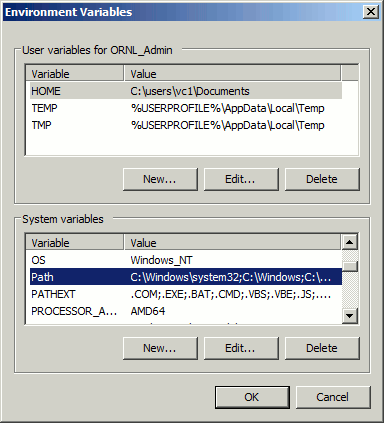
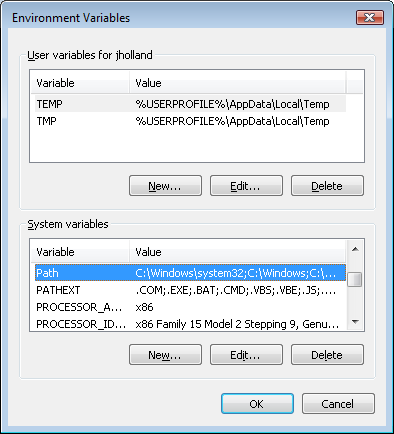
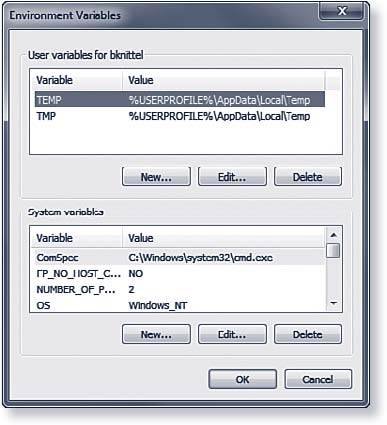
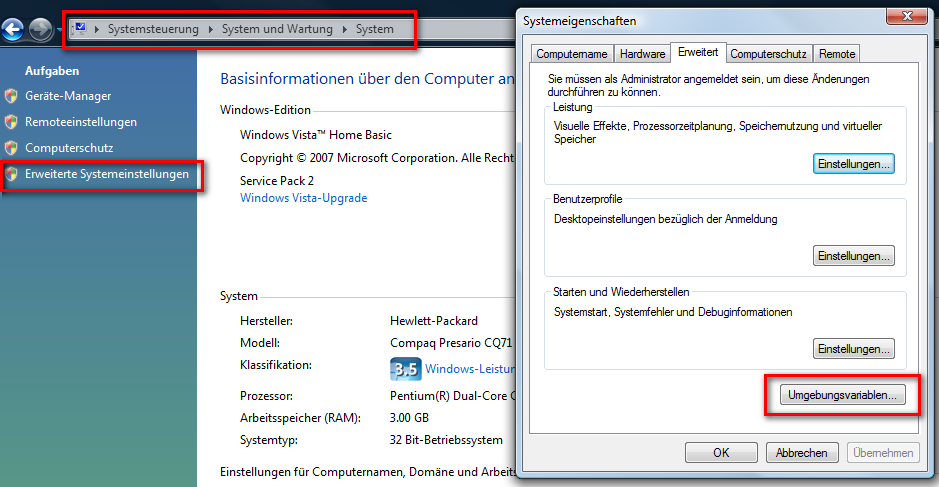
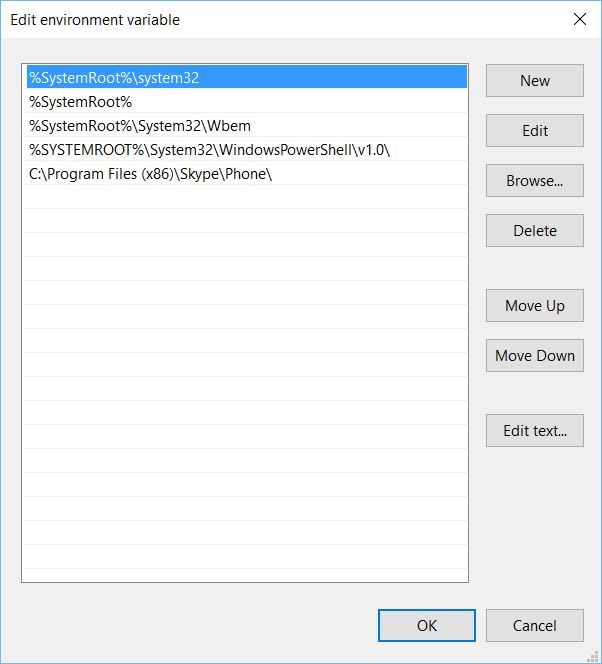
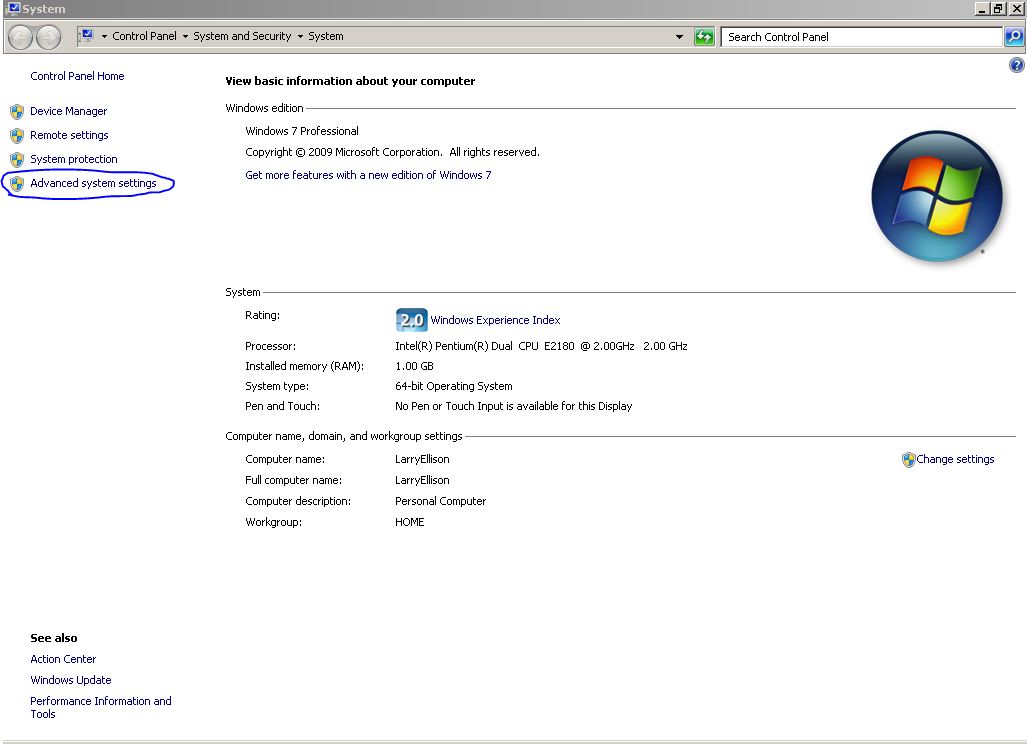
Double Click on you Path (if you want to just change you path for your login, use the top one, if you want to change it for all logins, use the bottom one). I've been trying to add the Python path to the command line on Windows 7, yet no matter the method I try, nothing seems to work. I've used the set command, I've tried.
The first time using the regular Regedit allowed me to go back in and change them back to C: \ from P: \. I was trying to re- install using the Recovery Partition, which required I put the installation path back to C: \ before I could. If I ever need to (and I will) re- install Win 7 again, I would now have to use the system image as there is no where I can see to change things back. If the system image goes wrong, it appears I’ll be up a creek. I finally discovered how I could make recovery disks but am unclear whether I would need to change the P: \ back to C: \. I don’t think so, but I am pretty confused at this point. I did a complete system image prior to installing Acronis Disk Director and partitioning, then redirecting the installation path.
I’ve never had any success backing up anything. I have never tried a system image restoration, so not sure how reliable they are. I really just want to set everything up ascustomized and streamlined as possible and attempt a complete system image containing the way I’dwant Windows to load up just the pre- installed programs of my choice, not theirs. Without unnecessaryduplication of files or folders. Would anyone be able to solve any of my questions? I know this will work just great once I’ve worked out the wrong turns taken!
Thanks for any help!!
This book describes the Microsoft-supplied command interpreter on Windows NT, Windows XP, Windows Vista, Windows 7 and later, which is cmd.exe. This article contains basic information to help with the use of the WinZip Command Line Support Add-on. It is intended for users who are not experienced with command. Note - Trying to install the JDK on a non-supported version of Microsoft Windows or on a machine that doesn't have a sufficiently up-to-date Service.
By default, Windows installs all the programs in C:Program Files or C:Program Files (x86) directory depending on the type of Windows 10 and program you a. Questions about setting environment variables the PATH are very common here, and in most cases the answers are very similar to each other. In the future it would be. This post explains how to set PATH environment variable from windows command prompt.
Symbolic link - Wikipedia. In computing, a symbolic link (also symlink or soft link) is the nickname for any file that contains a reference to another file or directory in the form of an absolute or relative path and that affects pathname resolution. Today they are supported by the POSIX operating system standard, most Unix- likeoperating systems such as Free.
BSD, Linux, and Mac OS X. Limited support also exists in Windows operating systems such as Windows Vista, Windows 7 and to some degree in Windows 2. Windows XP in the form of Shortcut files. Overview. This other file or directory is called the . The symbolic link is a second file that exists independently of its target.
If a symbolic link is deleted, its target remains unaffected. If a symbolic link points to a target, and sometime later that target is moved, renamed or deleted, the symbolic link is not automatically updated or deleted, but continues to exist and still points to the old target, now a non- existing location or file. Symbolic links pointing to moved or non- existing targets are sometimes called broken, orphaned, dead, or dangling. Symbolic links are different from hard links. Hard links do not link paths on different volumes or file systems, whereas symbolic links may point to any file or directory irrespective of the volumes on which the link and target reside. Hard links always refer to an existing file, whereas symbolic links may contain an arbitrary path that does not point to anything.
Symbolic links operate transparently for many operations: programs that read or write to files named by a symbolic link will behave as if operating directly on the target file. However, they have the effect of changing an otherwise hierarchical filesystem from a tree into a directed graph, which can have consequences for such simple operations as figuring out the current directory of a process.
Even the Unix . Some shellsheuristically try to uphold the illusion of a tree- shaped hierarchy, but when they do, this causes them to produce different results from other programs that manipulate pathnames without such heuristic, relying on the operating system instead. This is accomplished with several mechanisms, such as variant, context- dependent symbolic links. This offers the opportunity to create a more intuitive or application- specific directory tree and to reorganize the system without having to redesign the core set of system functions and utilities. POSIX and Unix- like operating systems. The ln shell command normally uses the link.
When the ln - s flag is specified, the symlink() system call is used instead, creating a symbolic link. Symlinks were introduced in 4. BSD Unix from U. C. Berkeley. The following command creates a symbolic link at the command- line interface (shell). Usually the target will exist, although symbolic links may be created to non- existent targets. Any file system management commands (e. Commands which read or write file contents will access the contents of the target file.
The rm (delete file) command, however, removes the link itself, not the target file. The POSIX directory listing application, ls, denotes symbolic links with an arrow after the name, pointing to the name of the target file (see following example), when the long directory list is requested (- l option). When a directory listing of a symbolic link that points to a directory is requested, only the link itself will be displayed. In order to obtain a listing of the linked directory, the path must include a trailing directory separator character ('/', slash). Note: In Below Example do not create .
The file contained the textual reference to the link’s target, and an indicator. An improvement, called fast symlinks, allowed storage of the target path within the data structures used for storing file information on disk (inodes). This space normally stores a list of disk block addresses allocated to a file.
Thus, symlinks with short target paths are accessed quickly. Systems with fast symlinks often fall back to using the original method if the target path exceeds the available inode space. The original style is retroactively termed a slow symlink. It is also used for disk compatibility with other or older versions of operating systems.
Although storing the link value inside the inode saves a disk block and a disk read, the operating system still needs to parse the path name in the link, which always requires reading additional inodes and generally requires reading other, and potentially many, directories, processing both the list of files and the inodes of each of them until it finds a match with the link's path components. Only when a link points to a file in the same directory do . However, the POSIX standard does not require the entire set of file status information common to regular files to be implemented for symlinks. This allows implementations to use other solutions, such as storing symlink data in directory entries. The file system permissions of a symbolic link are not used, the access modes of the target file are controlled by the target file's own permissions. Some operating systems, such as Free. BSD, offer the ability to modify file permissions and filesystem attributes of a symbolic link, through lchmod.
This is not to be confused with the shell command alias. Microsoft Windows. It was included with Windows XP, but was only enabled by default for kernel mode programs; Windows Vista and later versions of Windows enabled support for symbolic links to user mode applications, as well, and supplied the command line utility mklink for creating them. Third- party drivers are required to enable support for NTFS symbolic links in Windows XP. Additionally, the NTFS symbolic link implementation provides full support for cross- filesystem links.
However, the functionality enabling cross- host symbolic links requires that the remote system also support them. Symbolic links are designed to aid in migration and application compatibility with POSIX operating systems. Microsoft aimed for Windows Vista's symbolic links to .
For example, Windows Vista users must manually indicate when creating a symbolic link whether it is a file or a directory. Additionally, NTFS symbolic links to files are distinct from NTFS symbolic links to directories and therefore cannot be used interchangeably, unlike on POSIX where the same symbolic link can refer to either files or directories. In Windows Vista and later, when the working directory path ends with a symbolic link, the current parent path reference, ., will refer to the parent directory of the symbolic link rather than that of its target. This behaviour is also found at the shell level in at least some POSIX systems, including Linux, but never in accessing files and directories through operating system calls. For instance, bash builtin commands pwd and cd operate on the current logical directory. When any path is used with a system call, any use of . So, cd .; cat something and cat ./something may return completely different results.
Example. mklink /D . Junction points are for directories only, and moreover, local directories only; junction points to remote shares are unsupported. Most noticeably, Backup suffers from this problem and will issue an error message 0x.
One difference is what type of software is able to follow them: Symbolic links are automatically resolved by the file system. Any software program, upon accessing a symbolic link, will see the target instead, whether the program is aware of symbolic links or not. Shortcuts are treated like ordinary files by the file system and by software programs that are not aware of them. Only software programs that understand shortcuts (such as the Windows shell and file browsers) treat them as references to other files. Another difference are the capabilities of the mechanism: Microsoft Windows shortcuts normally refer to a destination by an absolute path (starting from the root directory), whereas POSIX symbolic links can refer to destinations via either an absolute or a relative path. The latter is useful if both the location and destination of the symbolic link share a common path prefix, but that prefix is not yet known when the symbolic link is created (e. Microsoft Windows application shortcuts contain additional metadata that can be associated with the destination, whereas POSIX symbolic links are just strings that will be interpreted as absolute or relative pathnames.
Unlike symbolic links, Windows shortcuts maintain their references to their targets even when the target is moved or renamed. Windows domain clients may subscribe to a Windows service called Distributed Link Tracking to track the changes in files and folders to which they are interested. The service maintains the integrity of shortcuts, even when files and folders are moved across the network.
Like folder shortcuts, they are transparent to the Windows shell. A minimal implementation is (the CLSID . It uses identical programming and user utility interfaces as Unix (see above), but creates Windows shortcuts (. Cygwin at the time of symlink resolution. Cygwin symlinks are compliant with both Windows and the POSIX standard.
Cygwin has no way to specify shortcut- related information – such as working directory or icon – as there is no place for such parameters in ln - s command. To create standard Microsoft . Cygwin provides the mkshortcut and readshortcut utilities.
Internally the dos. The Amiga. DOS shell will follow links automatically.
In the OS/2 operating system, symbolic links somewhat resemble shadows in the graphical Workplace Shell. However, shadows, due to the fully object- oriented System Object Model, are considerably more powerful and robust than a simple link. For example, shadows do not lose their capabilities when renamed or when either the object or subject of the link is relocated.
This allows some flexibility in filesystem order that is not possible with a standard symbolic link. Variables embedded in a symbolic link may include user and environment specific information.


/http%3A%2F%2Fimg.appnee.com%2Fappnee.com%2FMySQL-Front-3.png)
/http%3A%2F%2Fimg11.hostingpics.net%2Fpics%2F515193demo.png)
/https%3A%2F%2Fi.ytimg.com%2Fvi%2FPfwakKQe32o%2Fhqdefault.jpg)
/http%3A%2F%2Fpraxistipps-images.chip.de%2Fvl2DrcFGex8ZbikLhOsXm2A8iYY%3D%2F0x0%2Ffilters%3Ano_upscale%28%29%3Aformat%28jpeg%29%2Fwww.chip.de%2Fpraxistipps%2F1749351944_41f30ffca1.jpg)